
You probably know what you're supposed to be working on. Knowing doesn't reliably make the project move.
Maybe you've been rewriting the plan, doing another round of research, changing tools, waiting until you have a proper stretch of time, or putting in plenty of hours that somehow never get you closer to finished. The project isn't dead. It's just been at eighty percent for five weeks.
The instinct at that point is usually to make a bigger plan. A new system, a new app, a fresh timeline with the dates moved back. I've done this more times than I want to admit, and the new plan almost never fixes anything, because the plan was rarely the problem.
What I reach for instead is a reset with three questions in it. Stop, start, continue.
One project. One week. Three decisions.
Not your whole life, not a quarterly retrospective, and not every project you have running at once. Pick the one that's dragging and work out what needs to change between now and next weekend.
What to stop
This is the question that does the most work, and it's the one people skip.
When a project stalls, the assumption is that you haven't been trying hard enough. Usually you have been trying, and the effort has been going somewhere that feels productive while quietly pushing the finish line further away.
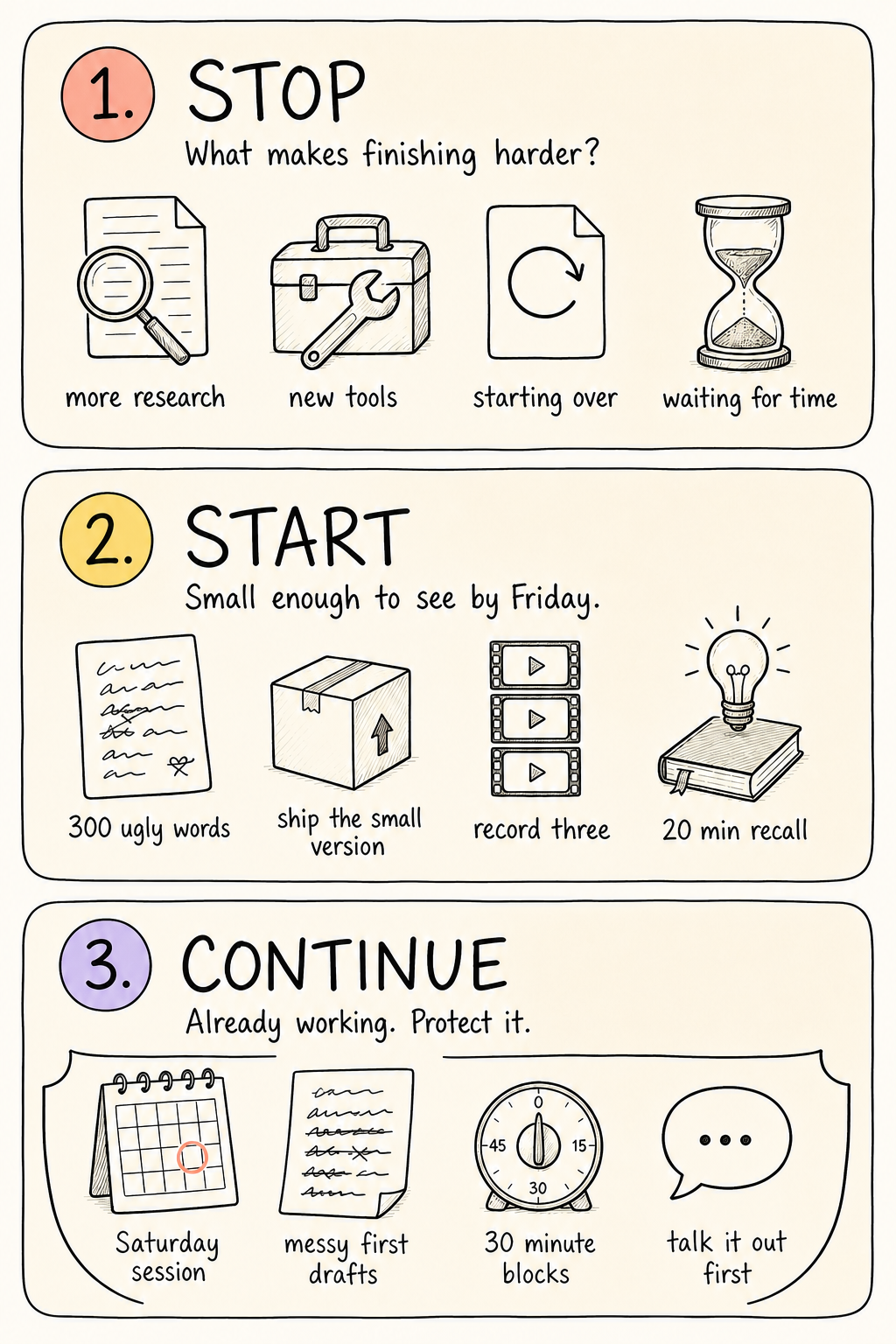
The usual suspects:
- researching after you already know enough
- changing the format
- starting over
- tweaking your tools
- adding new features
- comparing your project to someone else's
- waiting for a huge uninterrupted block of time
- reconsidering, again, whether the idea is any good
Every one of those looks like work from the outside. Some of them genuinely are work. They're just not the work that gets this project finished, and doing them lets you feel busy enough that you don't notice the project hasn't moved.
So the question is not "what am I doing badly?" That question sends you straight into a mood, and moods are not a project management technique. The question is "what am I doing that makes finishing harder?"
Those are different questions and they produce different answers. The first one is about your character. The second one is about your week, and your week is something you can change.
Pick one of them, not all eight. One thing you will deliberately not do for the next seven days.
What to start
Not someday, and not the perfect routine you'll begin once things calm down. One behaviour that would move this specific project forward.
If you're writing, that might be 300 ugly words before you're allowed to edit anything. If you're building something, ship the smallest version that works, even if it embarrasses you. If you're making videos, record three of them before you touch a thumbnail. If you're studying, spend twenty minutes actively recalling what you already learned instead of collecting more resources you won't read.
What makes a start useful is size. It has to be small enough that by the end of the week you can look back and see whether it helped. "Write more consistently" gives you nothing to look at. "300 words before editing, five mornings" either happened or it didn't, and if it happened you can see whether the draft grew.
Anything bigger than that isn't a start. It's another ambitious plan wearing a different hat, and you already established that the plan wasn't the problem.
What to continue
Most productivity advice quietly assumes everything about your process is broken and needs replacing. That's rarely true. Projects almost always contain something that's already working, and it tends to go unexamined because it isn't causing any trouble.
It might be your Saturday building session. Your messy first drafts. The weekly upload you've somehow kept going. Working in thirty-minute blocks. Talking an idea out loud before you try to write it down. Keeping the scope small enough that you can still see the end of it.
Whatever it is, name it. Write it down where you can see it, because a working habit is the first casualty when you decide to overhaul your entire system. You'll swap the Saturday session for a "better" daily schedule, and three weeks later you'll have neither.
Not every part of your process needs improvement. Some parts just need protecting.
And if it's working, you don't need to optimise it yet. Leave it alone and spend the attention somewhere that's actually stuck.
The exercise
Take one project. Open whatever you write in and answer three lines:
Stop: one thing I will deliberately stop doing this week.
Start: one thing I will begin doing this week.
Continue: one thing that's already helping, which I will keep doing and not touch.
That's the plan. Not seventeen action items with owners and due dates. Three decisions, and you can make all of them in about four minutes.
Then run the week and look at it again next weekend. Sometimes the stop was wrong, or the start was still too big, and you adjust. That's fine. A week is a cheap enough experiment that being wrong costs you almost nothing, which is the entire reason for keeping the window that short.
Change the conditions
A stuck project doesn't usually need more motivation. What it needs is different conditions around the work, and conditions are much easier to change than willpower is.
Remove one thing that's slowing you down. Add one thing that moves you forward. Keep one thing that's already working.
Then go and work on the project.